
Scottish Will Roles and Clauses | Plain-English Scotland Guide
A clear, plain-English explanation of the main roles and clauses in a Scottish will – including the testator, executors, guardians, beneficiaries, trusts and key wording you will see in most wills.

Last reviewed: 30 September 2026
This guide explains the main roles and clauses in a Scottish will in plain English. It is written for normal Scottish families who want to understand what the words in a will actually mean, without needing to be a lawyer.
Important: This is general information about Scots law. It is not legal advice. If your situation is complex or you are unsure about anything, you should speak to a Scottish solicitor.
If you simply want to put a straightforward will in place, you can make your Scottish will online here for a fixed price.
Contents
- 1. Overview: roles and clauses in a Scottish will
- 2. The key roles in a Scottish will
- 3. Typical structure of a simple Scottish will
- 4. Core Scottish will clauses explained
- 4.1 Revocation clause
- 4.2 Appointment of executors
- 4.3 Guardianship clause
- 4.4 Specific and cash gifts (legacies)
- 4.5 Residuary estate clause
- 4.6 Survivorship and substitution clauses
- 4.7 Trust clauses for young beneficiaries
- 4.8 Funeral wishes
- 4.9 Digital assets and online accounts
- 4.10 Pet care clauses
- 4.11 Administrative and investment powers
- 4.12 Signing and attestation wording
- 5. Common choices and trade offs
- 6. Common mistakes with roles and clauses
- 7. When you should speak to a Scottish solicitor
- 8. Next steps and useful links
1. Overview: roles and clauses in a Scottish will
When you look at a Scottish will, you are really looking at two things:
- The people involved – the testator, executors, beneficiaries, guardians, trustees and witness.
- The clauses – the actual wording that sets out what should happen to your estate.
Most simple Scottish wills follow a fairly standard pattern. The names and details change, but the structure is surprisingly similar from one person to the next. Once you understand the main roles and clauses, your will stops feeling like mysterious legal paperwork and starts to look like a clear set of instructions.
If you have not already seen it, you may find it helpful to read our Scottish Wills Guide first. You can also read our step by step guide on how to write a Scottish will which explains the overall process.
2. The key roles in a Scottish will
Every Scottish will is built around a few key roles. Understanding who these people are and what they do will make the rest of this guide much easier to follow.
Testator
Person making the will. Scots Law allows a will from age 12 where the person has testamentary capacity; the standard online service is for adults aged 18 or over.Executors
Administer the estate and distribute it after debts, taxes and claims.Guardians
Appointed under statutory conditions; acceptance and any surviving parent’s rights matter.Beneficiaries
People or organisations intended to receive gifts, subject to estate liabilities and applicable rights.Trustees
Manage funds held in trust under its terms and legal duties.Witness
Witnesses signing or acknowledgement and signs to support self-proving execution; does not certify capacity.
2.1 The testator
Sources: Age of Legal Capacity (Scotland) Act 1991 · ScottishWill Terms and Conditions
The testator is the person who is making the will. If you are writing your own will, you are the testator.
- In Scotland, a person aged 12 or over can make a will if they have testamentary capacity. ScottishWill’s standard online service is for people aged 18 or over.
- The will should clearly show your full name, address and often your date of birth.
- You normally sign the will yourself and must understand what it does. If you cannot sign, obtain Scottish legal advice about the special execution rules.
Your role as testator is to give clear instructions about:
- who should wind up your estate (your executors)
- who should look after any children under 16 (guardians)
- who should inherit what (beneficiaries)
- any other wishes you want people to know about (for example funeral preferences)
Our page on how to write a Scottish will goes into more detail about what information the testator usually provides.
2.2 Executors and substitute executors
Your executors are the people responsible for dealing with your estate after you die. They do the practical work, such as:
- finding and valuing your assets
- paying debts and funeral costs
- applying for Confirmation if needed
- distributing the estate to your beneficiaries
You can have:
- One sole executor – simple, but gives a lot of responsibility to one person.
- Two or more joint executors – often used for couples or families.
- Substitute executors – people who step in if the main executor cannot act.
We have a dedicated guide on this topic at executors in Scottish wills. It explains age limits, practical duties and how to choose the right person.
2.3 Guardians for children
Sources: Children (Scotland) Act 1995 · mygov.scot: appointing a guardian
A parent entitled to act as their child’s legal representative can appoint a guardian in a signed will or other written document to take effect on that parent’s death. The appointee must accept. A surviving parent’s rights continue alongside the guardian’s rights; the appointment does not automatically decide where the child will live.
- You can appoint one guardian or a couple.
- You can also name substitute guardians in case your first choice cannot act.
- It is sensible to tell your guardians that you have named them in your will.
You can read more about this in our dedicated guide on guardians in Scottish wills.
2.4 Beneficiaries and legatees
Your beneficiaries are the people or organisations who will inherit from your estate. You might leave:
- Everything to one person – for example your spouse or civil partner.
- Shares to several people – for example your children in equal shares.
- Specific gifts – such as a piece of jewellery or a lump sum of money.
- Charitable gifts – to a named charity with its registered charity number.
In some guides you will see the word legatee. This usually means the person who receives a specific gift called a legacy, for example a cash gift or a gift of an item. In everyday language, most people simply call them beneficiaries.
2.5 Trustees
Sources: Scottish Parliament briefing on trusts · GOV.UK: types of trust
In many Scottish wills, the executors are also appointed as trustees. Trustees hold and manage assets on behalf of someone else, usually:
- children or young adults who are not ready to inherit everything at once
- beneficiaries who need help managing money
- a group of people who will benefit from a fund over time
A typical Scottish will might say that the executors also act as trustees of any funds that need to be held until a child reaches, for example, 18, 21 or 25.
Executor, trustee and beneficiary roles can overlap, but each role has different responsibilities. An executor can also be a beneficiary. The timing of a trust distribution depends on its terms and the beneficiary’s rights; a bare-trust beneficiary in Scotland can generally demand the assets from age 16.
2.6 The witness
Sources: Requirements of Writing (Scotland) Act 1995 · Scottish Parliament briefing on wills
A witness sees you sign or hears you acknowledge your signature, then signs after you as part of one continuous process. They must be aged 16 or over, capable of acting as a witness and know who you are, or have credible information about your identity. A witness does not certify testamentary capacity or guarantee that a will cannot be challenged.
For a paper will, basic formal validity and self-proving status are different. Proper witnessing helps make the will self-proving, so its execution normally does not need separate proof. Follow the signing and witnessing instructions supplied with your Will Pack. More detail on this can be found in our how to write a Scottish will guide.
3. Typical structure of a simple Scottish will
There is no single official layout for a Scottish will, but most simple wills follow a familiar structure:
- Title and introduction – stating that this is the last will and testament of the testator.
- Revocation clause – setting out which earlier wills or codicils are to be cancelled.
- Appointment of executors – naming your main and substitute executors.
- Guardianship – if you have children under 16.
- Specific and cash gifts – any particular items or sums you want to leave.
- Residuary estate clause – who gets the rest of everything.
- Trust clauses – for young or vulnerable beneficiaries if needed.
- Funeral wishes – optional but often helpful.
- Administrative and powers clauses – authority for executors and trustees.
- Signing and witnessing section – where you and your witness sign.
The exact wording and order may vary, but the core idea is always the same. You are telling your executors who does what and who receives what.
If you want to see how these clauses sit within the bigger picture of Scottish wills, have a look at our Scottish Wills Guide.
4. Core Scottish will clauses explained
This section goes through the main Scottish will clauses one by one in plain English. The wording here is illustrative and not a template, but it should help you recognise what each part of your will does.
4.1 Revocation clause
Sources: Scottish Law Commission Report 215 · Scottish Parliament briefing on wills
An appropriately drafted revocation clause sets out which earlier wills or testamentary writings are cancelled. This helps avoid confusion if there are older documents still in a drawer somewhere. If you have wills covering assets in another legal system, obtain advice before using a broad revocation clause.
What it does:
- Confirms that this document is your latest will.
- Stops earlier wills or codicils from being used against your wishes.
Clear revocation wording helps avoid uncertainty about earlier wills or codicils. Without it, more than one testamentary document may need to be read together. Most modern wills include this clause near the beginning.
4.2 Appointment of executors
The appointment of executors clause names the people who will administer your estate. It is one of the most important parts of a Scottish will because these are the people who make sure everything is done properly.
What it normally covers:
- The full name and address of your main executor or executors.
- Whether they act alone or together.
- Substitute executors who can act if a main executor dies, resigns or is unable to act.
A simple clause might say that you appoint your spouse as your executor and, if they cannot act, you appoint another trusted person such as a sibling or close friend. You can read more about this in executors in Scottish wills.
4.3 Guardianship clause
Sources: Children (Scotland) Act 1995
A guardianship clause can appoint a guardian under the conditions explained in section 2.3. It does not override a surviving parent’s rights or guarantee a particular care arrangement.
What it normally covers:
- The full names of your chosen guardians.
- Whether they act alone or as a couple.
- Any substitute guardians if your first choice cannot act.
Guardianship and managing an inheritance are different roles. Executors administer the estate, and trustees manage funds held in trust under its terms. A guardian may also have duties concerning a child’s own property; a guardianship appointment does not make them trustee of every inherited fund. More detail is in our guardians in Scottish wills guide.
4.4 Specific and cash gifts (legacies)
Many Scottish wills include a section for specific gifts and cash legacies. These are separate from the main pot of your estate.
Examples:
- A particular piece of jewellery to a named person.
- A lump sum of money to a child or grandchild.
- A charitable gift to an organisation with its charity number.
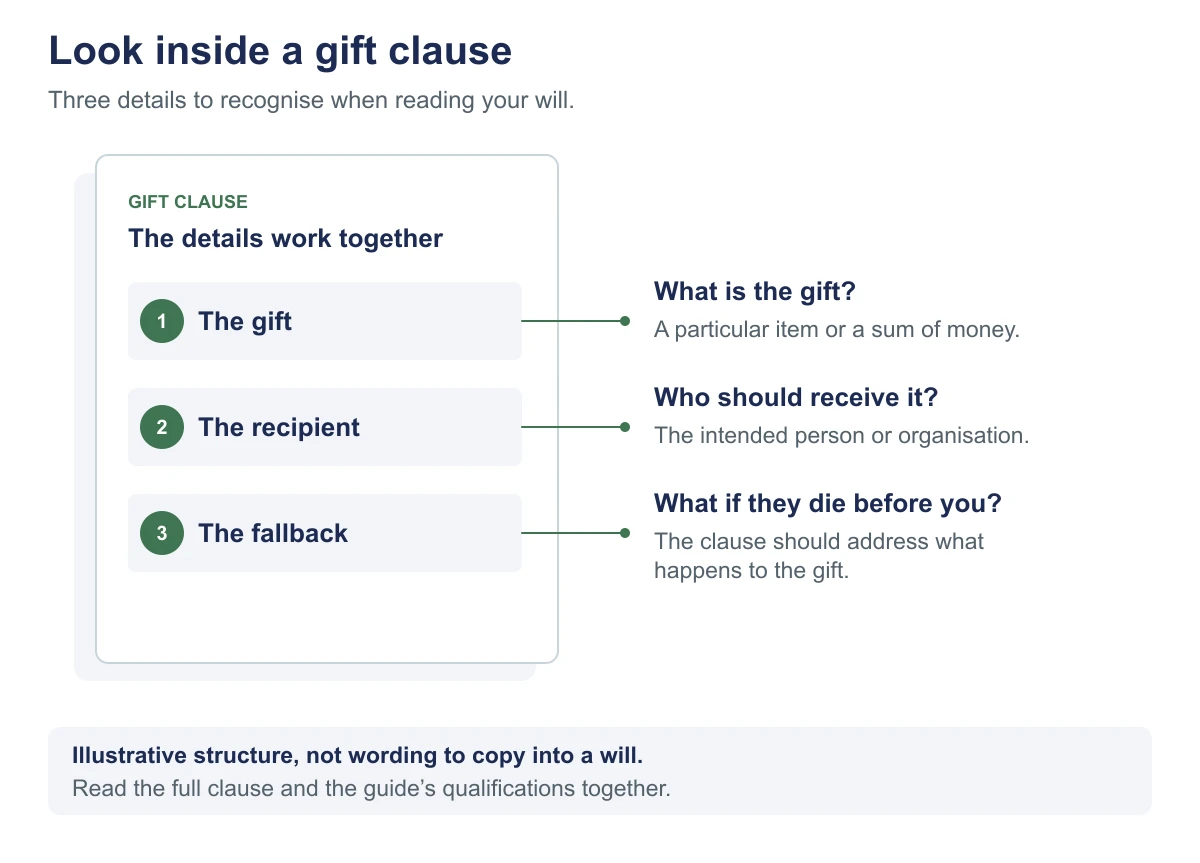
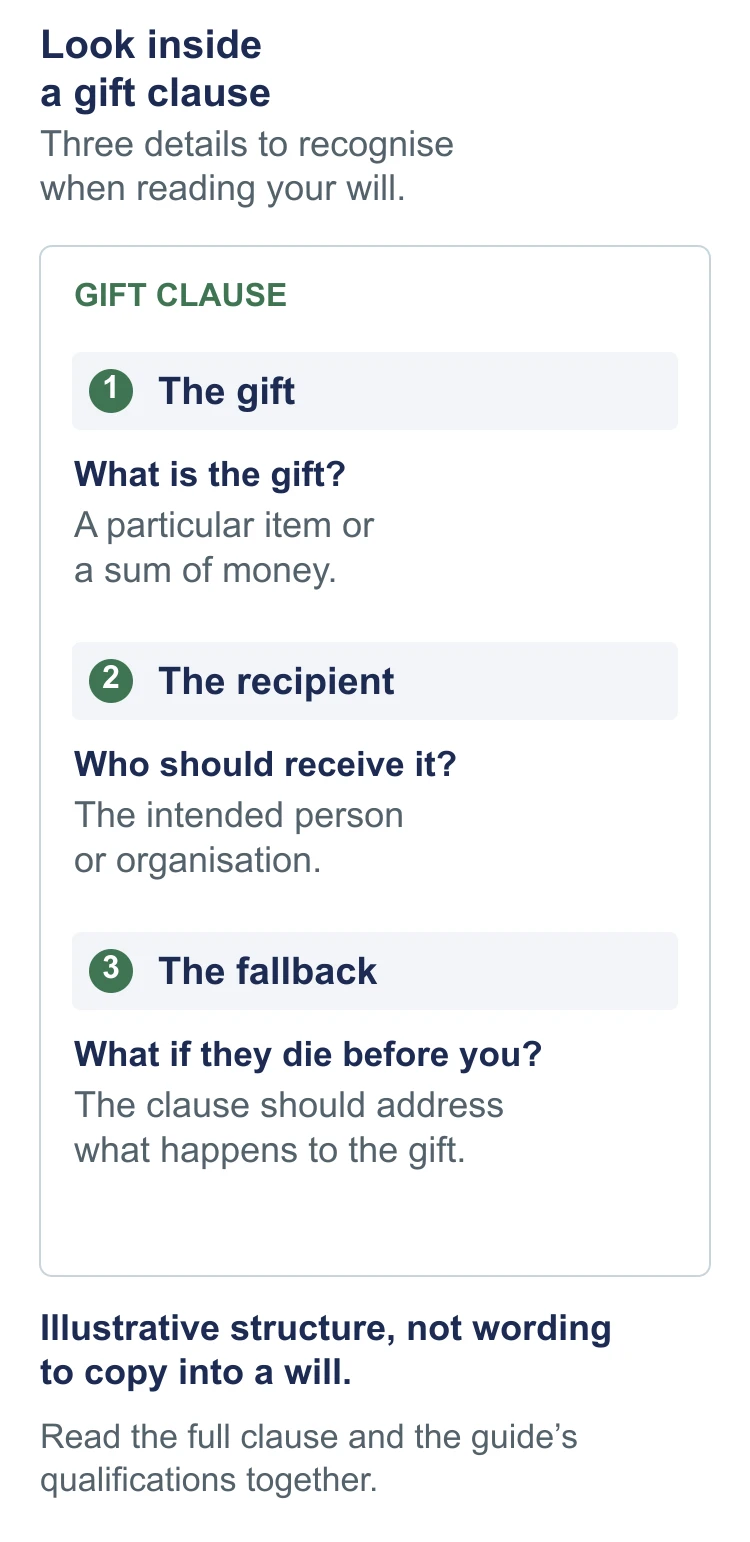
The clause usually sets out:
- What the gift is.
- Who should receive it.
- What happens if that person dies before you. For example, does the gift pass to their children or fall back into the main estate.
If you leave a lot of specific gifts, it is sensible to keep the wording clear and organised so your executors can follow it easily.
4.5 Residuary estate clause
Sources: Scottish Parliament briefing on wills
Your residuary estate is everything that is left after:
- Debts, taxes, funeral and administration expenses, and applicable claims have been dealt with.
- Specific gifts and cash legacies have been provided for.
The residuary clause is the part of the will that says who gets this remainder. It is often the most important clause in the whole will.
Typical examples:
- Leaving your whole residuary estate to your spouse or civil partner.
- Leaving it to your children in equal shares.
- Splitting it in set percentages between family members and charities.
In Scotland, spouses, civil partners and children can have legal rights to a share of the net moveable estate, whether or not there is a will. These rights can affect what is available under the residuary clause. Our main Scottish Wills Guide and our intestacy in Scotland page explain more about how estates are divided.
4.6 Survivorship and substitution clauses
Sources: ScottishWill Terms and Conditions
A survivorship clause deals with what should happen if someone dies shortly after you. For example, many couples state that the survivor must live for a set number of days to inherit. If they do not, the estate passes as if they had died first.
ScottishWill’s standard wills require a beneficiary to survive you by at least 30 days; otherwise the fallback provisions apply.
A substitution clause covers what should happen if a beneficiary dies before you. For example, you may want a deceased child’s share to pass to their own children instead of returning to the main estate.
These clauses help your executors avoid uncertainty. They also help keep money within the family in a way that matches your wishes.
4.7 Trust clauses for young beneficiaries
Sources: ScottishWill Terms and Conditions · GOV.UK: types of trust
In many Scottish wills, the residuary estate is left to children but not paid to them immediately. Instead, it is held in a trust for young beneficiaries.
Typical features:
- Children can benefit from income and capital while they are young. For example help with education or living costs.
- The timing of full payment depends on the trust terms and applicable beneficiary rights; some trusts specify ages such as 18, 21 or 25.
- If a child dies before that age, their share is redirected according to the terms of the trust.
In a simple will, executors may also act as trustees. ScottishWill’s standard terms provide for an inheritance due to a beneficiary under 18 at your death to be held by the executors until 18. That is the service’s stated arrangement, not a universal minimum age under Scots Law. Trusts intended to delay access beyond 18, vulnerable-beneficiary trusts or tax planning need tailored advice and may fall outside the standard service.
4.8 Funeral wishes
Funeral wishes in a Scottish will are usually expressions of preference, not legally binding instructions. Even so, they can be a helpful guide for your family.
Common points covered:
- Burial or cremation.
- Any preference about where your ashes should be scattered or where you should be buried.
- Ideas about the tone of the service. For example quiet and simple or more of a celebration.
Some people prefer to keep detailed funeral wishes in a separate Letter of Wishes so they can update it easily without changing their will.
4.9 Digital assets and online accounts
Sources: Google: inactive account options · Apple Legacy Contact
Many modern wills now include a short clause about digital assets. This covers things like email accounts, online subscriptions, social media profiles and cloud storage.
A digital-assets clause can record your wishes and help your executors request access or manage accounts. Access and transfer depend on the provider’s rules and the nature of the asset; a will does not guarantee access or ownership of every account. Use provider legacy tools where available and keep account information securely outside the will.
In practice, it is helpful to keep an up to date list of important accounts in a secure location and let your executors know how to find it. Do not write passwords directly into your will because the will may eventually become a public document.
4.10 Pet care clauses
A pet clause lets you say who should look after any animals you own at the time of your death. You can also leave a small cash gift to help with their care.
Typical examples:
- Asking a named person to take responsibility for your dog or cat.
- Leaving a sum of money to that person on condition that they care for the pet.
Pets are treated as property in law, so you cannot leave money directly to an animal. You can, however, leave it to a person or charity with a clear explanation of your wishes.
4.11 Administrative and investment powers
Sources: Scottish Parliament: Trusts and Succession Bill · Scottish Law Commission Trust Law Report
Most modern Scottish wills include a section giving your executors and trustees certain administrative powers. The powers available depend on the will, the trust terms and the law. Executors and trustees must use them properly and comply with their duties.
Common powers include:
- Power to sell or transfer property.
- Power to invest estate funds in a reasonable way.
- Power to insure property and pay necessary expenses.
- Power to advance money to beneficiaries in certain circumstances.
These powers are usually based on standard legal wording that has built up over time. For complex estates or specialised assets, you should seek advice from a Scottish solicitor.
4.12 Signing and attestation wording
Sources: Requirements of Writing (Scotland) Act 1995
The signing and attestation wording records execution of the will. The witness sees the signature being made or hears it acknowledged.
In Scotland, the key points are:
- Normally sign at the end of the last page; seek advice if you cannot sign.
- For self-proving status, sign every sheet of a multi-sheet will.
- The witness signs after you in one continuous process; record their name and address. Occupation may be requested by the form but is not a statutory requirement.
The formal rules about signing and witnessing Scottish wills are set out in the Requirements of Writing (Scotland) Act 1995. Our how to write a Scottish will guide explains the practical steps in more detail.
5. Common choices and trade offs
Sources: GOV.UK: types of trust · ScottishWill Terms and Conditions
When you build a Scottish will, you make a series of practical choices. There is rarely one perfect answer. Instead, there are trade offs.
Some of the most common choices include:
- One executor or two. One executor keeps things simple. Two or more can share the load and provide a back up if one person is ill or busy.
- Age for young beneficiaries. Paying everything at 18 gives early freedom but may feel too young for a large sum. A suitably structured trust may delay full access, but its terms and the beneficiary’s rights matter. Do not assume an age written in a will always prevents an earlier claim; delayed-access trusts need advice.
- Specific gifts versus leaving everything in one pot. Specific gifts can be thoughtful but may become out of date. A simple residuary gift is easier to administer.
- Detailed funeral wishes in the will or a separate Letter of Wishes. A short summary in the will plus more detail in a separate letter often works best.
If you are using an online Scottish will service, you will normally answer clear questions that guide you through these choices. Our own process at ScottishWill is designed for straightforward estates where the options can be handled through plain English questions.
6. Common mistakes with roles and clauses
Sources: Scottish Parliament briefing on wills
Clear instructions and careful signing can help avoid problems with a will. Understanding the roles and clauses can help you make informed choices.
- Not naming substitute executors. If your only executor dies before you or cannot act, your family may need to apply to court to have someone else appointed.
- Contradicting clauses. For example, promising the same asset to two different people, or setting up a trust that clashes with the residuary clause.
- Forgetting about legal rights. In Scotland, spouses, civil partners and children can have legal rights to part of the net moveable estate. A will does not automatically remove those rights.
- Leaving out pets, digital assets or guardianship. These can cause stress and uncertainty, even though they are simple to address in the will.
Our Scottish Wills Guide and Intestacy Scotland pages give a wider view of what happens when things are unclear.
7. When you should speak to a Scottish solicitor
Sources: ScottishWill Terms and Conditions
An online Scottish will service is designed for simple, sensible estates. There are situations where you should get tailored advice from a Scottish solicitor instead.
ScottishWill’s standard service is for Scottish-domiciled adults aged 18 or over, with testamentary capacity and acting voluntarily, and straightforward estates up to £750,000 gross. It excludes overseas property or foreign assets, complex trusts or life interests, inheritance tax planning and business succession unless separately agreed in writing. ScottishWill is not a law firm and does not provide legal advice.
You should consider speaking to a solicitor if:
- You have a very large or complex estate.
- You own property outside Scotland or outside the UK.
- You are trying to exclude a spouse, civil partner or children from your will.
- There are serious family disputes or a real risk of the will being challenged.
- You want to set up detailed trusts or tax planning arrangements.
- You have a business, partnership interest or complex shareholdings.
You can find solicitors through the Law Society of Scotland Find a Solicitor service. If you have concerns about professional conduct, the Scottish Legal Complaints Commission has further information.
8. Next steps and useful links
Sources: ScottishWill Terms and Conditions · ScottishWill service information
If you have read this guide, you now understand the main roles and clauses in a Scottish will. The next step is to decide whether you are ready to put a will in place.
Useful next steps on our site:
- Read the full Scottish Wills Guide for a broader overview.
- Learn how to write a Scottish will step by step.
- Understand intestacy in Scotland and what happens if there is no will.
- Read more about executors in Scottish wills and guardians in Scottish wills.
External resources:

Ready to put your will in place?
If your circumstances fall within our standard service scope, you can give your instructions through our guided online form. Complete the signing and witnessing steps supplied with your Will Pack before treating it as ready for use.
Make My Scottish Will – From £125Prepared from a Scots Law clause library | Reviewed for completeness and consistency before delivery
The form is designed to take around ten minutes per person; allow longer if you need to gather information or consider your choices. We aim to email completed Will Packs within two business days; busy periods may take up to five business days and incomplete information can extend delivery. Weekends and UK public holidays are excluded. For mirror wills, timing depends on both completed forms. Delivery times are targets, not guarantees.