
SCOTTISHWILL GUIDES
What Happens If You Die Without a Will in Scotland?
Intestacy in Scotland is the legal process that decides who inherits when someone dies without a will.

This plain-English guide explains what happens in Scotland if someone dies
without a valid will. It covers how the estate is divided, who has first claim,
what “prior rights” and “legal rights” mean, and why relying on the default rules can cause
real problems for families.
It is written for normal Scottish families who want clarity, not legal jargon.
It is general information only and is not legal advice. If your
situation is complex or disputed, you should speak to a Scottish solicitor.
If you simply want to avoid intestacy and put your own wishes in place, you can
make a Scottish will online using our guided service:
Make My Scottish Will
(simple, fixed-fee online will for people living in Scotland).
If you want to understand more about how wills work generally, you can also read our
Scottish Wills Guide and
our step-by-step article on
how to write a Scottish will.
Contents
- 1. What is intestacy in Scotland?
- 2. When do intestacy rules apply?
- 3. How a Scottish estate is divided with no will
- 4. Example scenarios – who inherits what?
- 5. Key terms: prior rights, legal rights, free estate
- 6. What about cohabitants and stepfamilies?
- 7. How Scotland differs from England & Wales
- 8. Why relying on intestacy can cause problems
- 9. How to avoid intestacy (and keep control)
- 10. Quick FAQs about intestacy in Scotland
- 11. Further reading and useful links
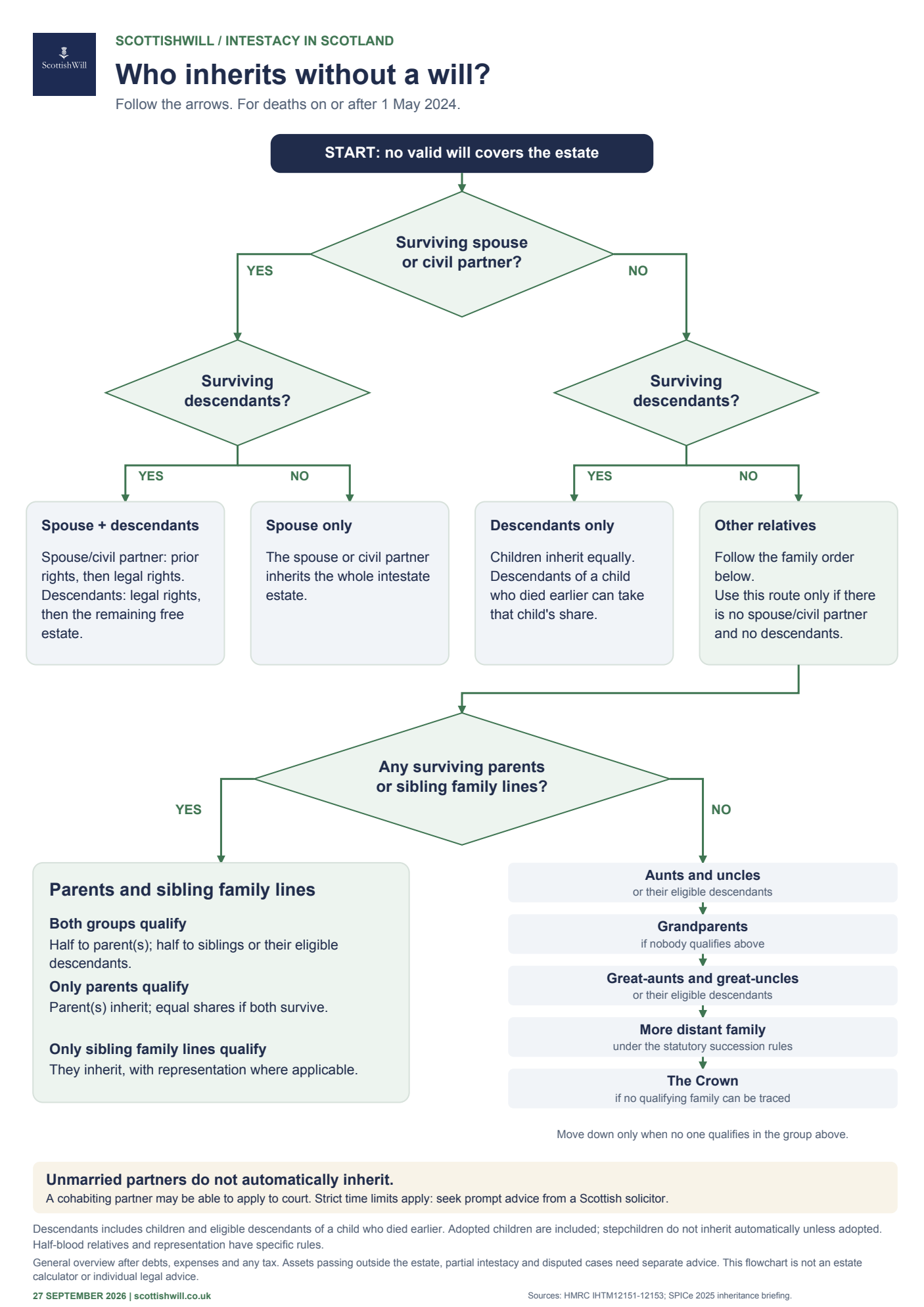 Open or download the full-size flowchart (PDF, 20 KB)
General information, not individual legal advice.
1. What is intestacy in Scotland?
In Scotland, a person is said to have died intestate if they die without leaving a valid will, or if the will they left is not legally valid or does not deal with their whole estate. When this happens, their money, property and possessions are not divided according to personal wishes. Instead, they are distributed according to the statutory rules of intestacy, mainly found in the Succession (Scotland) Act 1964 and updated by more recent legislation. Intestacy laws are designed to provide a default pattern of inheritance that feels “broadly fair” in common family situations, but they:- do not take account of your personal relationships
- do not reflect modern blended and stepfamilies very well
- may give rights to people you wouldn’t choose to benefit
- can make things slower, more stressful and more expensive to sort out
2. When do intestacy rules apply?
The Scottish rules of intestacy normally apply when:- someone dies without any will at all; or
- there is a document, but it is not valid as a will under Scots Law; or
- the will only deals with part of the estate, and the rest is left “unallocated”.
- people who always meant to “get round to it” but never did
- homemade wills that were not signed properly or do not dispose of the whole estate
- old wills with gifts that fail or no effective provision for the remaining estate
- using a template that does not meet Scottish requirements
3. How a Scottish estate is divided with no will
When there is no valid will, a Scottish estate is generally divided in three main stages:- Prior rights of the surviving spouse or civil partner
- Legal rights of spouse/civil partner and children over moveable estate
- The remaining free estate, shared among relatives in a fixed order
- the surviving spouse or civil partner has strong initial claims
- children have rights to a share of the moveable estate
- other relatives inherit only if there is no surviving spouse, civil partner or descendant
3.1 Prior rights – the spouse or civil partner’s first claim
Prior rights only apply if there is a surviving spouse or civil partner. They do not apply to cohabitants or partners who were never married or in a civil partnership. In broad terms (and subject to statutory limits that can change over time), prior rights give the surviving spouse or civil partner:- a right to the family home (up to a maximum value) if they were living there
- a right to the furniture and contents (up to a set value)
- a right to a cash sum from the estate (with different limits depending on whether there are children)
3.2 Legal rights – spouse and children’s shares of moveable estate
After prior rights are met (if they apply), the next layer is legal rights. These apply to the moveable estate only, which generally means everything except land and buildings. Both the surviving spouse/civil partner and any children (including adopted children) can have legal rights. These are normally expressed as fractions of the moveable estate, such as:- the spouse or civil partner may be entitled to a one-third share of the moveable estate
- the children together may also be entitled to a one-third share, split equally between them
3.3 The free estate – what is left after prior and legal rights
Only one of those groups qualifies: that group takes the whole.
Neither group qualifies: move through aunts and uncles, grandparents, great-aunts and great-uncles, then further family under the statutory rules. The Crown is the final recipient if no qualifying family can be traced. Eligible descendants can sometimes take a deceased relative’s place. Half-blood relatives and representation have specific rules, so the full family tree matters. HMRC: other relatives · Scottish Parliament: inheritance law.
- children, or descendants taking the place of a child who died earlier
- if there are no surviving descendants, the spouse or civil partner
- if neither group survives, parents and siblings or eligible descendants of siblings, followed by more distant relatives in the statutory order
- if no qualifying relatives can be traced, the estate may ultimately pass to the Crown
4. Example scenarios – who inherits what?
Every estate is different, but it can help to see some simplified examples of how intestacy might work in practice. These are illustrative only and are not a substitute for legal advice.4.1 Example 1 – Married couple with children, no will
Situation:- John dies in Scotland without a will.
- He leaves a wife, Mary, and two children.
- The family home and contents are in his name.
- He has savings and a car (moveable estate).
- Mary’s prior rights may give her a claim over:
- the home (up to the statutory value limit)
- the furniture and contents (up to the limit)
- a cash sum from the estate
- After that, Mary and the children as a group have legal rights to shares of the moveable estate.
- Any remaining free estate goes to the two children in equal shares.
4.2 Example 2 – Long-term cohabiting couple, no will
Situation:- Anne and David have lived together for 15 years in Scotland but never married.
- The house is in Anne’s name.
- Anne dies without a will.
- She has no children but has a brother and elderly parents.
- David is not a spouse or civil partner, so he has no prior rights.
- He also has no automatic legal rights to moveable estate.
- Some relatives (such as parents and siblings) may inherit instead under the rules.
- David may be able to apply to the court as a cohabitant for a share of the estate – but this is not guaranteed and can be stressful and expensive.
4.3 Example 3 – Blended family and children from a previous relationship
Situation:- Mark is remarried and has one child from a previous relationship plus two children with his new spouse.
- He dies in Scotland without a will.
- His current spouse may still have prior rights and legal rights claims.
- All of Mark’s children, including those from his previous relationship, may have legal rights to the moveable estate.
- Any remaining free estate goes to Mark’s three children in equal shares.
5. Key terms: prior rights, legal rights, free estate
Here is a quick reference for some of the most important concepts in Scottish succession law:5.1 Testator
The testator is the person who makes a will. In an intestacy, we still talk about “the deceased” or “the estate”, but there is no testator’s written instructions to follow.5.2 Estate
The estate is everything a person owns at the time of their death, after debts and funeral expenses are taken into account. It is usually divided into:- Heritable property – mainly land and buildings in Scotland.
- Moveable property – money, savings, investments, vehicles, furniture, personal possessions and so on.
5.3 Prior rights
Prior rights are the first claims on an intestate estate, given to a surviving spouse or civil partner. They cover:- the right to the family home (within certain value limits)
- the right to furniture and household contents (again, up to a limit)
- the right to a cash sum
5.4 Legal rights
Legal rights are claims that a surviving spouse/civil partner and children have to the moveable estate, whether or not there is a will. In an intestacy they form part of the default structure; where there is a will, they can sometimes be claimed instead of what was left in the will. These rights cannot easily be ignored, which is why careful planning matters if you are trying to be very specific about who does and does not benefit.5.5 Free estate
The free estate is what remains after:- debts and funeral expenses are paid
- prior rights are satisfied (if there is a spouse/civil partner)
- legal rights are taken into account
6. What about cohabitants and stepfamilies?
Modern Scottish families are often more complicated than the traditional married couple with two children. Unfortunately, intestacy rules were not written with every modern situation in mind.6.1 Cohabitants (unmarried partners)
If you lived with someone as a couple but were not married or in a civil partnership, you are treated as a cohabitant, not a spouse. As a cohabitant you do not automatically inherit under intestacy rules. Instead, you may have to apply to the court within a strict time limit asking for a share of the estate. The court has discretion, and there is no guarantee you will receive what you feel is fair. In Scotland, cohabiting couples have no automatic inheritance rights under the intestacy rules. Our dedicated guide explains what this means and how a will can protect your partner. For more detail, you can also refer to guidance from the Scottish Government or speak to a Scottish solicitor.6.2 Stepchildren
Stepchildren are not automatically treated in the same way as biological or adopted children under intestacy rules. If you die without a will, they may receive nothing from the estate, even if you treated them as your own. If you want to provide for stepchildren, foster children or anyone else who would not automatically inherit, you generally need a valid will that clearly names them. Our article on Scottish will roles and clauses can help you understand the main building blocks.6.3 Second marriages and blended families
Intestacy can be particularly awkward where there are:- children from earlier relationships
- a new spouse or civil partner
- tensions or estrangement between relatives

Avoid intestacy – put your own wishes in writing
If you die without a will in Scotland, the law decides who inherits. If you make a valid Scottish will, you decide instead. Our online service is designed for straightforward Scottish estates – clear questions, plain-English explanations, and a fixed fee. Make My Scottish Will Takes around 10 minutes to complete. Your Will Pack is reviewed and sent within 2 business days.7. How Scotland differs from England & Wales
Many will templates and online articles are written for England & Wales, not Scotland. While there are similarities, there are also important differences in both intestacy and will requirements. Some of the key differences include:- Age to make a will – in Scotland, a person can generally make a will from age 12; in England & Wales the usual age is 18.
- Witnessing – a self-proving Scottish will normally has the testator sign each page and one witness sign the last page; in England & Wales, two witnesses are normally needed.
- Legal rights – Scotland has a distinctive system of legal rights in moveable estate for spouses/civil partners and children, which can apply whether or not there is a will.
- Terminology – Scottish courts talk about “confirmation” of an estate, whereas in England & Wales the equivalent is a “grant of probate”.
8. Why relying on intestacy can cause problems
Some people assume that “it will all just go to my other half anyway” or that the law will “more or less do what I would have done”. In practice, relying on intestacy can create real difficulties.8.1 People you care about may receive nothing
Common risk areas include:- cohabiting partners with no legal status as spouse or civil partner
- stepchildren you treat as your own, but who are not legally adopted
- friends, carers or charities you might have wanted to benefit
8.2 Family disputes and delays
Where there is no clear written will, it can be harder for families to agree on what the deceased “would have wanted”. That can lead to:- arguments between surviving partner and adult children
- tension between children from different relationships
- longer, more expensive administration of the estate
8.3 No control over timing or conditions
Intestacy rules do not allow you to:- delay a child’s inheritance until a chosen age
- require property to be sold or retained
- include special protections for vulnerable beneficiaries
- make small gifts of sentimental items to particular people
9. How to avoid intestacy (and keep control)
The only reliable way to avoid intestacy is to have a valid, up-to-date will that covers your Scottish estate clearly. That will should:- be written with Scots Law in mind
- identify you properly as the testator
- appoint one or more executors you trust
- set out who is to inherit your estate, and in what shares
- explain what should happen if a beneficiary dies before you
- be properly signed and witnessed in line with Scottish requirements
- guide you through the key questions in plain English
- flag when your situation might be too complex for a simple will
- produce a will that is tailored to Scotland, not another jurisdiction
- provide clear signing instructions so your will is validly executed