
Do I Need a Solicitor to Make a Will in Scotland?
A solicitor is not required for every will in Scotland. Whether you should obtain legal advice depends on your circumstances, assets and wishes, and whether you can give clear instructions and understand the document.

This guide explains when Scottish legal advice is advisable, when an online service may be suitable, and what to check before choosing an approach. It provides general information, not legal advice.
Last reviewed: 12 October 2026.
Short answer
No, a solicitor does not have to draft every Scottish will. A will prepared without a solicitor can be legally valid, but suitable wording, testamentary capacity, free choice and proper execution matter. For an ordinary paper will:
- Use clear wording suitable for Scots Law.
- Normally sign at the end of the last page; obtain Scottish legal advice if you cannot sign.
- For self-proving status, sign every sheet of a multi-sheet will and use a suitable witness. They see you sign or hear you acknowledge your signature, then sign after you in one continuous process.
The key question is not “is a solicitor required?” but rather “is my situation simple enough to handle without one?”
Sources: Requirements of Writing (Scotland) Act 1995; Scottish Parliament research briefing; Age of Legal Capacity (Scotland) Act 1991
When you usually do NOT need a solicitor
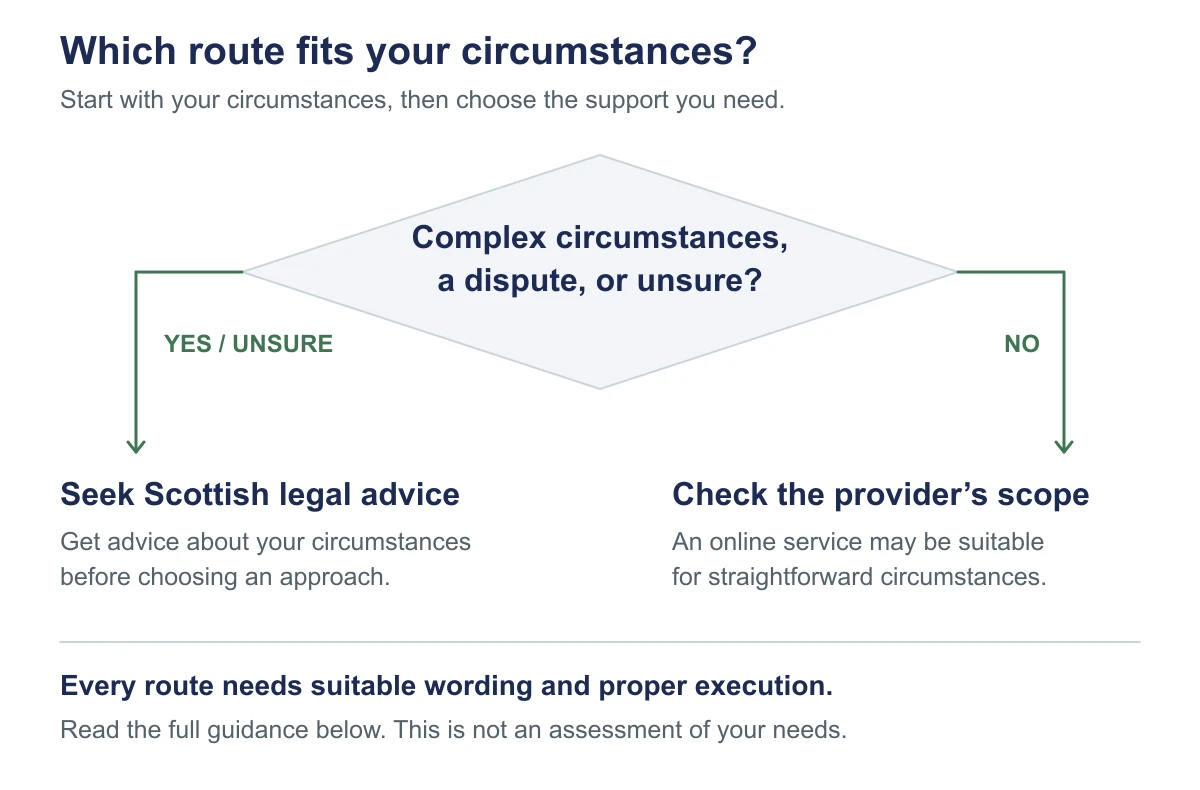
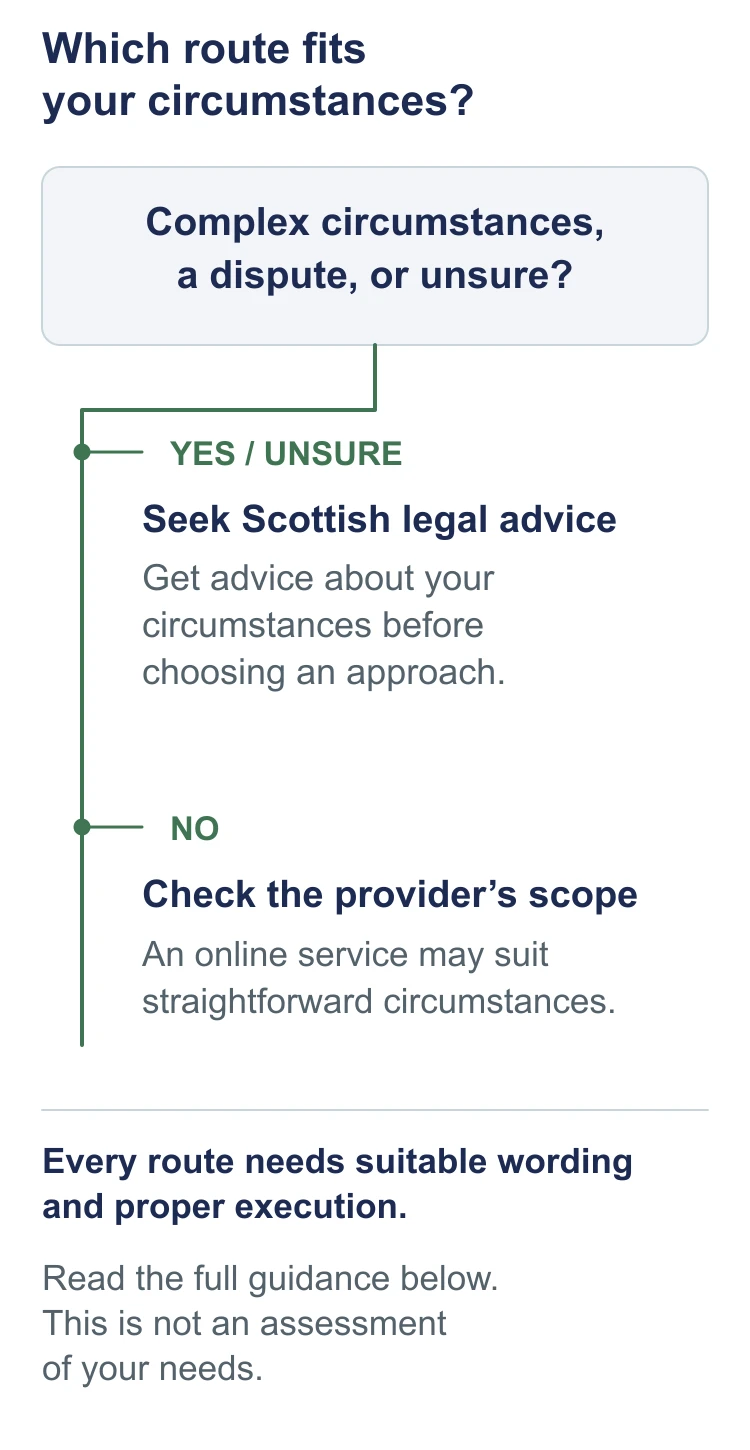
An online service may be suitable for straightforward circumstances, but these examples are not a legal assessment of your needs. Check the provider’s eligibility and scope before choosing it:
- Your assets and wishes are straightforward, with no business succession planning.
- You want to leave assets to your partner, with clear fallback gifts to children or other named beneficiaries.
- You have no overseas property or foreign assets.
- You are not seeking advice about excluding a spouse, civil partner or child.
- You can give clear instructions, read the document and follow the execution instructions.
Possible approaches include:
- A guided online Scottish will service, or
- A carefully chosen Scottish will template.
If you want background on how Scottish wills work in general, see our Scottish Wills Guide.
Sources: ScottishWill Terms and Conditions; Requirements of Writing (Scotland) Act 1995
When you SHOULD use a Scottish solicitor
There are situations where professional legal advice is strongly recommended. You should speak to a Scottish solicitor if:
- Your estate is high value or you need inheritance tax advice.
- You need business succession advice or have complex investments.
- You own property or assets governed by another legal system.
- You need a complex trust or life interest.
- You have a blended family, unclear wishes or expect disputes.
- You want to exclude a spouse, civil partner or child: their legal rights may still apply to your net moveable estate.
A solicitor can assess your circumstances and explain your options. Ask for the scope of work and a fee quote before deciding.
Sources: Requirements of Writing (Scotland) Act 1995; Scottish Parliament research briefing
What about online Scottish will services?
Online providers differ in their eligibility, document preparation and support. ScottishWill’s standard service is for people aged 18 or over, domiciled in Scotland, acting freely with capacity, and with straightforward estates of gross value up to £750,000. It excludes overseas property or foreign assets, complex trusts, life interests, inheritance tax planning and business succession unless a different scope is agreed in writing. ScottishWill is not a law firm and does not provide legal advice.
- A displayed service price and defined scope.
- Scots Law wording assembled from a fixed clause library for the standard service.
- A guided intake form, with documents reviewed for completeness and consistency with your instructions.
- Signing instructions that you remain responsible for following.
A will prepared online can be legally valid if it is suitable for Scots Law and properly executed, with capacity and free choice. This guide concerns online preparation followed by a printed paper will. Read more here: Are Online Wills Legal in Scotland?
Sources: ScottishWill Terms and Conditions; Requirements of Writing (Scotland) Act 1995
Solicitor vs online service vs DIY template
For simple Scottish wills, the differences usually come down to cost, support, and risk tolerance:
- DIY templates: You choose suitable wording and take responsibility for completing and executing the document.
- Online Scottish services: Check the price, eligibility, support and what any document review covers.
- Solicitors: Can provide tailored legal advice; ask for a quote and the services included.
If you are comparing costs, see our full breakdown: How Much Does a Will Cost in Scotland?
Common mistakes when skipping a solicitor
Problems can arise if you:
- Used wording meant for England and Wales.
- Did not understand executors or substitute beneficiaries.
- Signed the will incorrectly.
- Did not update the will after major life changes.
Clear guidance and careful checking can help, but they do not replace tailored advice when your circumstances require it.
Sources: Requirements of Writing (Scotland) Act 1995; Scottish Parliament research briefing

So — do you need a solicitor?
If your circumstances are complex, disputed or high value, seek tailored Scottish legal advice before choosing an approach.
If your circumstances are straightforward and fall within the chosen provider’s scope, an online service may be suitable. Check the document and follow the signing instructions carefully.
If you want a structured, Scottish-specific approach without solicitor appointments, you can make a Scottish will online here